A sample text widget
Etiam pulvinar consectetur dolor sed malesuada. Ut convallis
euismod dolor nec pretium. Nunc ut tristique massa.
Nam sodales mi vitae dolor ullamcorper et vulputate enim accumsan.
Morbi orci magna, tincidunt vitae molestie nec, molestie at mi. Nulla nulla lorem,
suscipit in posuere in, interdum non magna.
|
After reading the compost tea section of “Teaming with Microbes”, a book I highly recommended, their DIY compost tea setup was simple enough that I decided to try it out. At the end of the post I will include pics of my setup which is super easy, relatively cheap (very cheap when compared to commercial stuff) and produces a completely filtered compost tea ready for application with a sprayer or watering can. But first lets talk a little about actively aerated compost teas (AACT).
If you’re an organic gardener, of course you know the benefits of compost, whose praises have been sung far and wide. The smell of fresh, healthy, finished compost is one of my favorite smells in the world. That earthy aroma in a good compost is the smell of billions of microbes going about their microscopic business as they break down the organic matter and feast on it (and each other!). After reading “Teaming with Microbes” I now have have a vastly new appreciation for the mind blowing, complex ecosystems of microbes that exist in our gardens. They live and die by the trillions within the soil, at the roots of plants (rhizosphere) and on plant leaves (phyllosphere). A well aerated compost is shock full of these guys.
With an actively aerated compost tea, compost is soaked in water and aerated with a commercial aerator or other aerating device like an aquarium pump. The constant movement of the bubbles both provides air to the microbes in the compost and teases them out of the filter and/or soil medium so they can multiply within the tea solution. A good aerated compost tea is like putting compost on steroids (very briefly – and, you know, in a healthy way). In AACT the bacterial population can explode from a mere 1 billion per tsp to 4 billion per tsp. Since it is aerated, these are still the same kinds of organisms that we encourage when we build an aerated compost pile. Of course, AACT is NOT compost because it doesn’t contain the copious amounts organic matter that compost does and so all these happy microbes living in your AACT need a place to go and eat before they start to eat themselves (yikes!). To feed them, let them go to town in your yard. The authors report that it is virtually impossible to over apply compost tea. Even if you watered your plants ONLY with a AACT, the microbes will adjust to the amount of available nutrients on the leaves and in the soil. It will not burn roots or leaves and they state “it will only help increase the diversity of microbial populations in your soil”. They recommend a twice a year application, but if you really wanted to go crazy you could apply AACT as often as you water.
The reported benefits of aerated compost teas are numerous as the folks at Soil Food Web Inc eagerly demonstrate in this article. Because the tea is so rich in microbes, it is a good for the restoration of soil after chemicals have been used on it. Even synthetic fertilizers can be devastating to the life in your soil, so frequent use of compost tea is great for transitioning to organic gardening. An added benefit of compost teas is that they can be applied to leaves. So while compost can only be used directly to improve the diversity of the rhizosphere (roots), compost tea can be used improve the diversity of the phyllosphere (leaves) as well as the rhizosphere. Aerated compost teas are also reported to help suppress disease, but unfortunately not a ton of study has been done on aerated compost teas. I recently read a crotchety article (pdf) about the “myth” of disease suppression. Something isn’t a myth until proven false, so I prefer “unproven hypothesis” since at this point in time, a thorough study has not been done particularly on the disease suppressing abilities of compost tea. Which means we have to experiment and judge for ourselves at this point. So lets get to it! At the very basic level we know that healthy plants repel insects, and healthy environments promote healthy plants and healthy environments are ones with lots of soil diversity…….ergo……AACT is a good tool in your gardening tool box. With each application of a compost tea is the chance that another lucky beneficial microbe will find their unique place in your garden ecosystem.
A few guidelines for brewing and applying teas:
- For foliar application, apply to both sides of the leaves if possible
- Apply it in the morning or evening as the heat and wind of the day will reduce the microbe’s chance to get a foothold
- Use aerated compost tea immediately after brewing as the populations will begin to die off once aeration stops.
- Brew your tea at room temperature, colder temperatures inhibit growth, hot temperatures fry microbes.
- A good aerated tea should be coffee brown and have a rich earthy smell.
- The height of microbial growth is between 24 and 36 hours.
A simple starting recipe for a five gallon batch is non-chlorinated water, 2 cups compost, 2 tablespoons of molasses, fruit juice, cane syrup or maple syrup (to get the party started). To de-chlorinate water, let your aerator run in the water for about 2 hours before adding tea ingredients. If you have a recipe that you would like to share or have had obvious success with compost tea, please comment below. I am just beginning and would love to know more. When posting a recipe, if you could include a little detail on why you use that particular recipe that would be awesome.
Here is my simple setup: all told it cost me maybe $30 and produces more than enough tea for my 1/4 acre yard. It took me, mmmm, 15 minutes to assemble and get my first brew bubbling.
1 Aquarium pump (Tetra Whisper for 40 gallon aquarium – probably overkill, but hey I want bubbles!)
3 feet of clear 1/4″ tubing
2 feet of 1/4″ soaker hose (for drip systems)
1 3 prong 1/4″ tee for drip systems, used to put the soaker hose in a hoop
1 5 gallon bucket
1 pair of Size Q pantyhose
[simage=69,320,y,none]
[simage=70,320,y,none]
[simage=71,320,y,none]
[simage=72,320,y,none]
[simage=68,320,y,none]
The tea pictured above is my first mix, called Kablooey! tea. I used fresh stinging nettle, worm castings, finished compost and orange juice.
The method above is a filtered application for use as a foliar spray and topical soil drench. There are other methods that include a lot of organic matter and could be a beneficial soil additive. For some more ideas, check this article out.
Here is an interesting post of someone using a couple different compost tea methods to try and get weakened plants to buck up.
[simage=75,288,y,none]
Thymus citriodorus variegata
Lemon thyme is one of my go-to plants in the garden. The variagated variety has beautiful foliage, the smell and flavor of the leaves are wonderful and it tolerates a wide range of growing conditions. In the ideal setting it would prefer well drained soil and full sun. However, the plant pictured above is in a moderate amount of shade (it gets about 2-3 hours of noon sun) and has grown well over the six months since I propogated it from my original plant.
It is drought tolerant, and in my experience lemon thyme tolerates a fair amount of abuse as well. I have moved the original plant after it was established. I have divided it twice. On a couple occasions after accidentally pulling off some woody material, I just treated the accident like a start and stuck it into soil, kept it moist and viola, I had a new thyme plant! Very easy to propagate. The picture below is the original plant. It is looking leggy right now, but that is most likely due to the fact that it is winter and it is still recovering from getting moved in fall. Come spring if I keep it trimmed down (very likely since I use it constantly), it will gain a nice compact, bushy form about 6″ to 8″ high.
[simage=74,288,y,none]
Ornamental Uses
Lemon thyme has a semi-creeping upright growth habit and will form a low mound as it matures. The young leaves are bright lime green, they then turn to a darker green and ultimately mature (about a year later) into the variegated foliage. It is a beautiful accent plant, useful in borders and is great in a rock garden. If there were a perfect place to put lemon thyme, it would be at the edge of a waist-high rock wall. Its colors would make it pop out against the stone and the leaves just beg to be touched and smelled. You can see in a couple of these pictures, the dark greens and bright yellows are a nice contrast to the bamboo border of one of my beds. It is also a useful companion plant for vegetables, as the oils in thymus spp. discourage some pests and inhibit harmful bacteria and fungi.
Culinary Uses
Anywhere that you use mint, try using lemon thyme either as a substitute or as a complimentary flavor. Also, for dishes that ask for thyme, you might try using lemon thyme instead. It has a very unique flavor and I like throwing a few leaves of it into practically anything because it brings an interesting accent flavor. Best of all though, it is wonderful in herbal teas. I make a mint, sage, basil, thyme and green tea fusion that is probably one of my favorite drinks ever. As one of the “world’s healthiest foods“, you can’t go wrong!
[simage=76,288,y,none]
For more information on thymes in general you can check out this article . There are many varieties of thyme, each with their own unique characteristics and flavor. It is definitely a plant worth experimenting with.
[simage=15,200,n,none] I’d like to introduce you to my favorite plant in the garden at the moment. It is Bronze Arrow lettuce grown from seed that I received in a seed swap at the 2008 Bioneers conference. A California heirloom variety, it is my first step towards bringing in heritage varieties into my garden. While at the Bioneers conference, I also had the pleasure of listening to a local foodshed panel with Gary Nabhan, Michael Dimock and Jo Ann Baumgartner . It was there that I was introduced to the concept of a foodshed and the need to strengthen local foodsheds as a way to work towards more sustainable communities.
That was just a few months ago and the issues like food security and diversity were inspiring but didn’t feel extremely urgent. Yet as drought continues to hammer us, the federal water supply is planned to be cut off to California farms in March and the fragility of our food system starts to show through. Suddenly local resilience has an obvious and pressing appeal. Especially when staring at the fact that California produces over half of the nations vegetables, fruits, and nuts. If our drought persists, the prices for produce will creep up, further aggravate the current economic quagmire and push people deeper into the cheaper, less healthy processed foods that already dominate our diet.
It doesn’t have to be that way though, our gardens and community spaces provide so many answers as we gaze down the road at the continued drought and further in the distance (probably much closer than we would like) at declining soil, increased competition for oil, an uncertain climate and a finite global water supply. As a way to spread out safety nets and mitigate these tough challenges, we have to grow more food locally. A huge part of that involves growing varieties local or adapted to our area. Local heritage varieties have stood the test of time and thrive in the local growing conditions while resisting local diseases and pests. They bring great resilience to our food supply. I personally can’t wait to get the rest of my seed swap goodies into the ground so that I can do my part to carry on the tradition, and keep our seed supply flowing.
For those interested, here are a few great ways to find local and national heritage varieties:
Local seed swaps are an excellent place to start, as the seeds that are being exchanged have stood the test of your bioregion, and were deemed worthy of exchange by the person who brought them and you may be able to glean growing tips as well. If you can, be sure to bring your own seed successes to share when you go and keep the cross pollination going!
Check out the Ark of Taste! The wonderful people at Slow Food USA have drawn up a list of foods that are US heritage foods with superb flavor. There is a list of foods by region so see what pops up for your state.
For those of you in California, be sure to check out this publication of California RAFT foods (pdf) to discover California foods that are at risk. Since they are “at risk”, these may be difficult to find. If you are growing ANY of the plants on this list, please, please, please let me know!!! (Email me: chris at porchsideecology dot com). I am trying to find people who have these varieties. For more information on Renewing America’s Food Traditions (RAFT) you can check out their website.
If you are looking for Monsanto-free, organic, non-GMO, heirloom seeds: a good resource is Freedom Seeds . The Dervaes down in SoCal have put a lot of hard work to compile and package a catalog of seeds that promote seed sovereignty.The website is still in the works, but they are currently taking seed orders. I’ve been a big fan of the Dervaes for a while now and when I found out about their seed project, I ordered a few packets of seeds to support the cause and try out some new things. Their service was fast and my seeds are sprouting away.
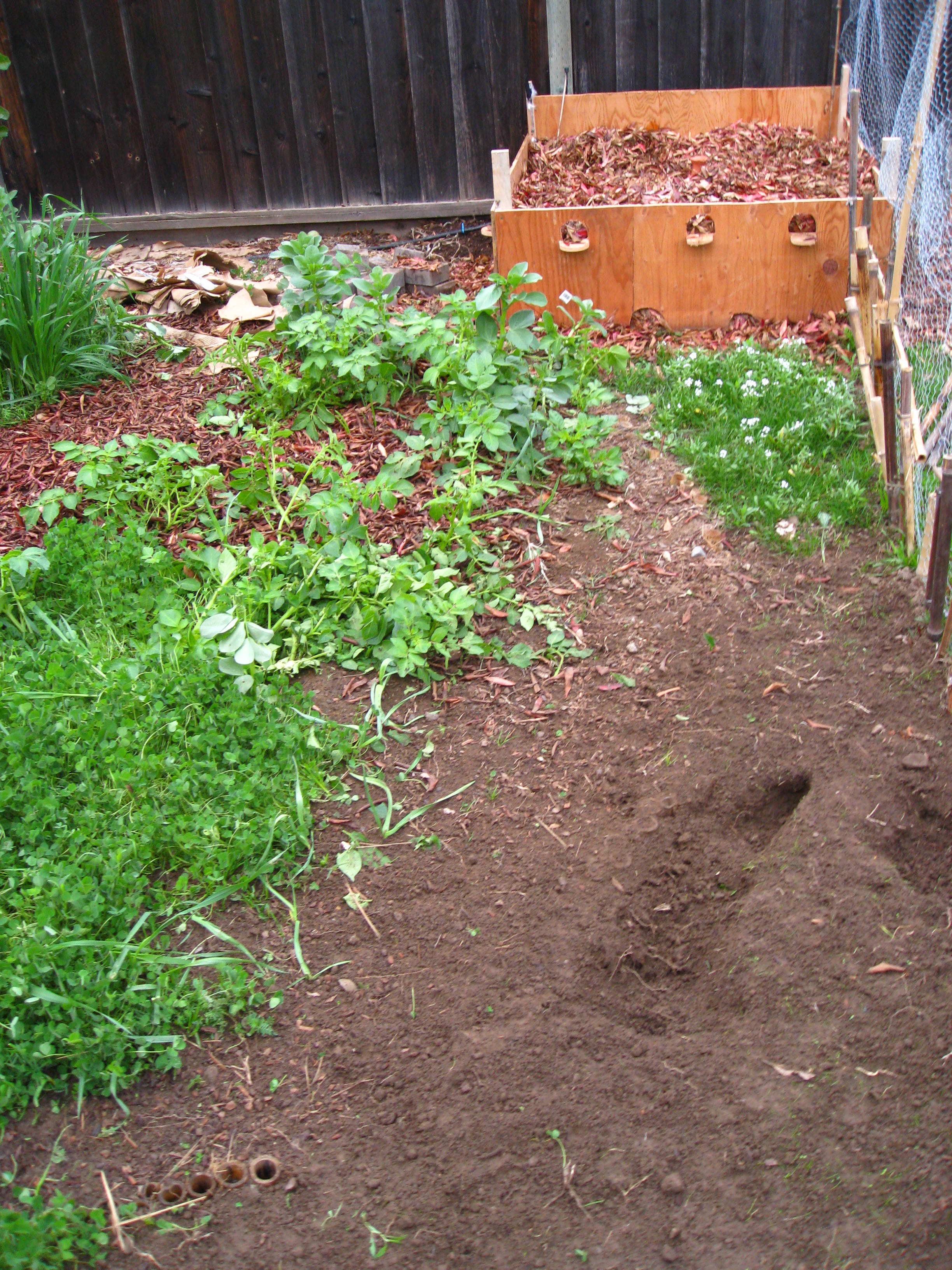
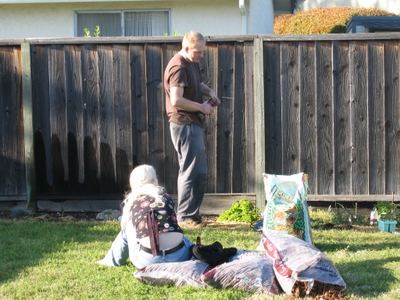 An innocent start to the year. It all began with some herbs a few zucchini and tomatoes 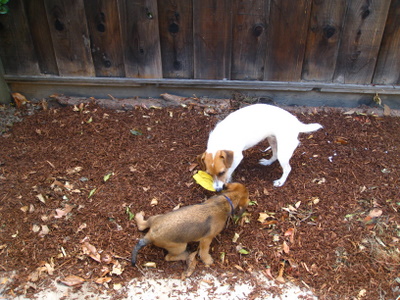 Big changes are afoot, August saw the addition of a hugelkultur bed by the patio. Beneath the bark mulch lie two shallow trenches (maybe 12" to 18" deep?) with young cypress that were cut down next door. On top of the trenches is a light sheet mulch with manure, cardboard, an inch or two of yard waste and the bark on top. Now, how do I keep these furry garden pests from destroying too much? 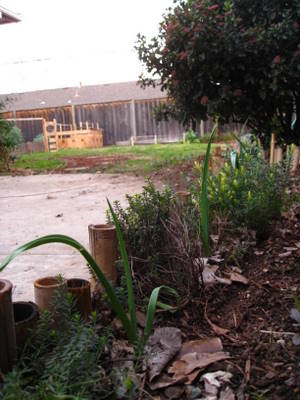 The "hugelbed" in January 2009. Planted with garlic, thyme, brown arrow lettuce (outside the photo frame) and some ornamental annuals that stuck around. It doesn't get very much sun right now (a couple hours at best) but the plants seem to be doing well, except for the lantanas which had to be moved to sunnier pasture. In the background you can see the main garden taking shape. Somehow, I trained the dogs to stay out of the hugelbed (so far anyway), yet they continually find ways to get into The Lab and dig! 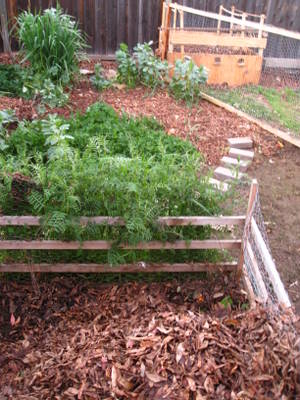 January 2009 Work in progress (isn't it always!). This is "The Lab", my main garden. I am trying different experiments within The Lab areas. A biointensive bed lies beneath the clover and other cover crops. Off to the left is a section that I am reserving as my "what would nature do" plot in which I simply try to mimic nature's patterns in my garden. I intend to pattern it off of the edge between a forest and meadow, in which plants are kept down by "grazing", mulched by leaves and other forest debris and receive the occasional deposits from "flooding" (i.e. composting) in my little ecosystem. I intend not to till that area if at all possible. Should be interesting. Oh! And right next to the compost bin I am trying to cultivate mushrooms (Hypsizygus ulmarius "Garden Patch")! I hope it works. 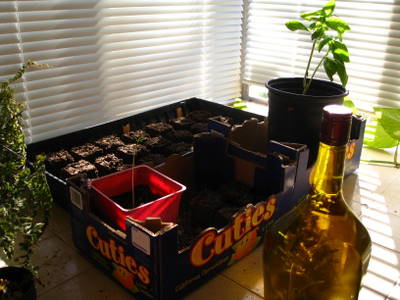 My first soil blocks to start out the new year. Can't wait to see what this year holds!
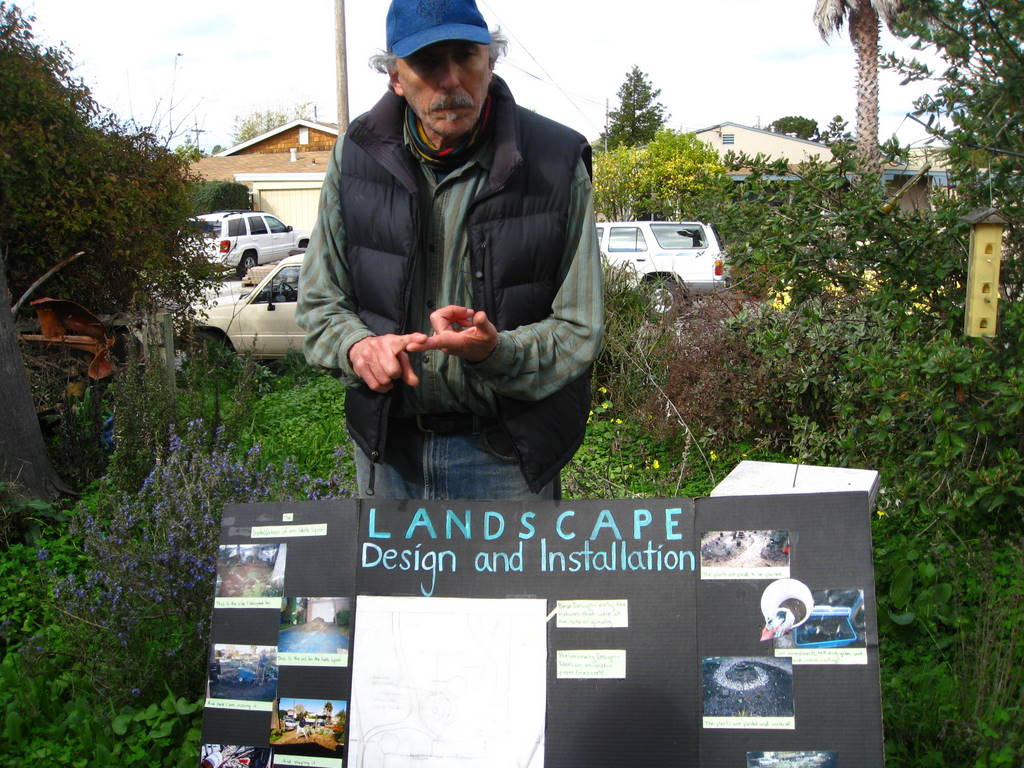
Recently I had the pleasure of meeting Ken Foster at his home for a tour of his garden. Ken is the owner of the ecological landscaping company TerraNova Landscaping. While strolling about his diverse 1/4 acre lot, we talked a lot about the other sustainable practices in his business because it is something I hope to do myself in the near future here in San Jose. As was immediately obvious by his driveway (slowly being claimed by potted plants) and his garage (reserved for his bike), he integrates sustainability into his life and business. The TerraNova maintenance crews also use bikes and bike carts for the day to day maintenance. They definitely bust out the trucks for major installations, but for the routine work, they try to use low impact, low noise methods (like electric mowers, blowers). TerraNova does beautiful work (photos here), and it’s fascinating stuff, but it’s time to get back to the point of this post!
His garden.
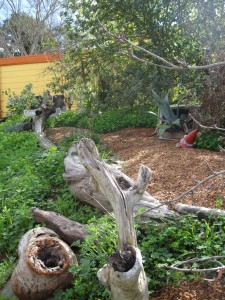
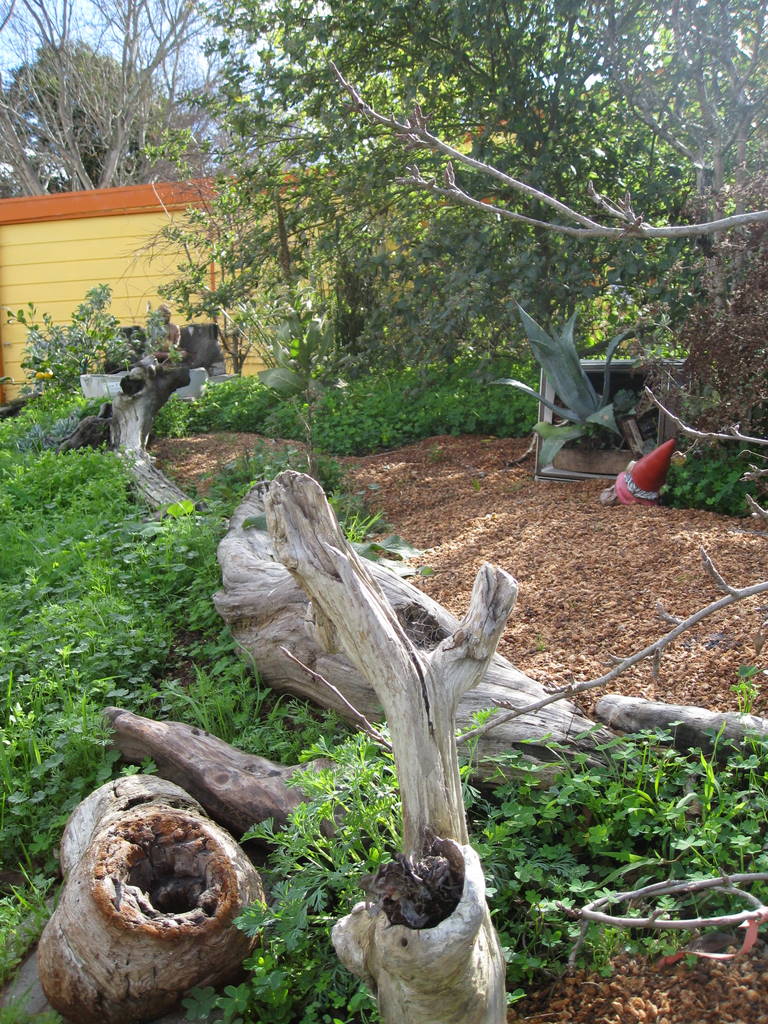
Even though it is the cool season (one can hardly call it “winter” in Santa Cruz), his front yard is flush with food, herbs and habitat. Ken noted that he likes to let things run a little wild in his yard, but he pointed out that what many might mistake to be weeds, are in fact self-perpetuating sources of food that readily reseed and grow themselves with little to no input on his part. As you can see in the photos, even with a looser, wilder growth pattern, it is a beautiful landscape accented by driftwood and quirky garden art.
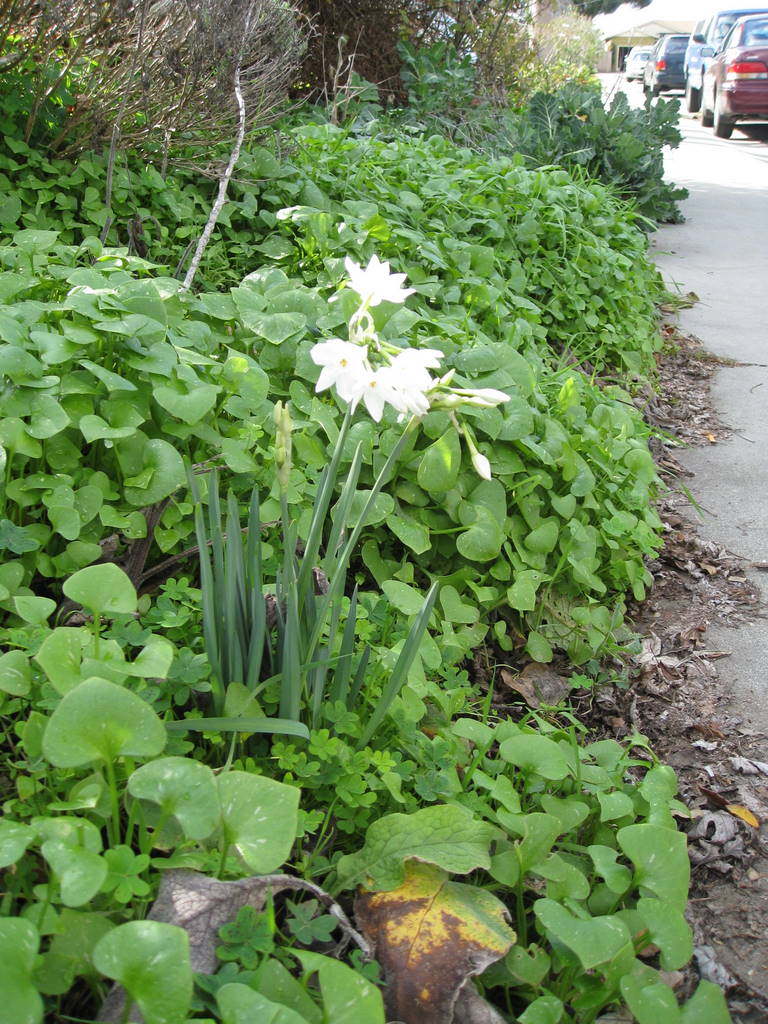
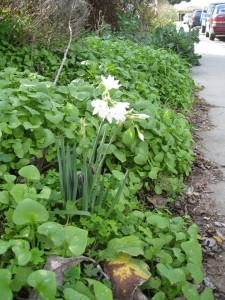 The miner’s lettuce shown on the right is an excellent example of a how wonderful a weed can be. It is actually a multi-functional, low input plant and these attributes are highly valued within permaculture design. It is a beautiful ground cover that provides a living mulch, it is also a delicious green (I tasted it and I am very picky when it comes to greens!), it sows itself, and it is native to this area so it demands little attention. Definitely a “weed” that I wouldn’t mind popping up in my own garden.
The miner’s lettuce is growing on the edge of a bioswale that collects the rain runoff from the walkway and his house roof. The swale stops the flow of the water, spreads it over a small area and sinks it into the ground to create a lens of water which the fruit trees, the miner’s lettuce and the host of other plants on the swale can tap into as they need it. The swale serves a very, very important function but it also smells reaaaaaally good. Ken has partnered with a local tea business named SunChai to help them reduce their waste. He takes their spent chai mix and makes a Chai Mulch that he personally uses and sells to others. It is a beautiful mulch, it smells great and is a excellent example of a positive mutual exchange between two businesses to cycle materials.
Below are a few more photos, but I’ll have to leave it that. There was so much more going on and I didn’t even get past the front yard in this post. If you are in Santa Cruz and get the chance, I recommend arranging a tour with Ken and he can tell you all about permaculture, TerraNova, Transition Santa Cruz and other exciting things that he’s involved in. If you do drop in on Ken, ask him to show you the “Rock Star” ceanothus (it performed at the Cow Palace!).
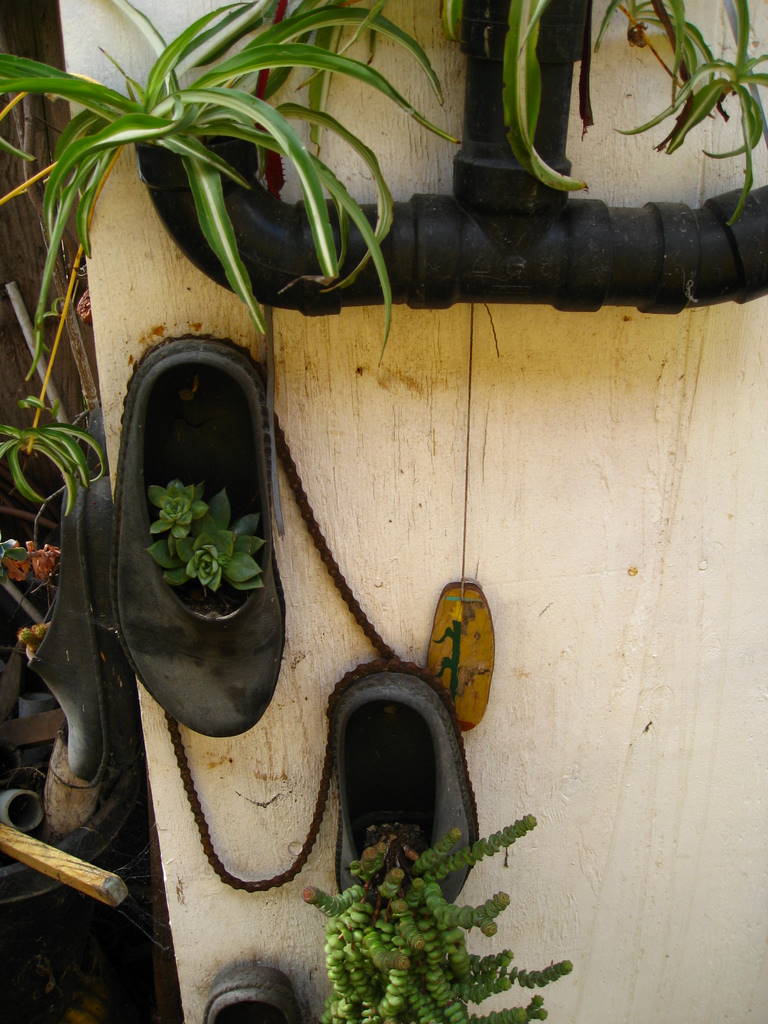
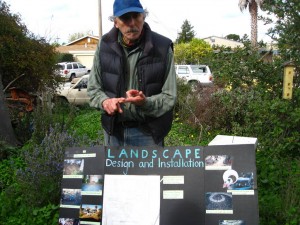 Ken demonstrating the spiral herb garden that he and his daughter did years ago for a school project 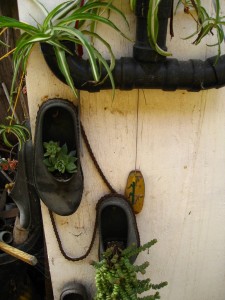 plants fit snugly in Ken's repurposed shoes
As fields and beds lie fallow and frozen throughout most of the country, winter tends to be the season of reflection and planning for most horticulturists. Even though the San Jose “winter” here in California is actually a productive growing season with only the occasional serious frost, I thought I would honor the winter tradition and look back on my year.
A lot changed for me in 2008. It started innocently enough with the extension of my small herb bed by adding some sage, basil, tarragon and chamomile. I also started a few tomatoes and a couple zucchini plants. My aims were modest and fit in well with my full time school and part time work schedule (working from home is awesome). But then, along came Gaia’s Garden  , which I think was given to me around my birthday at the end of March. I devoured it, reading it from cover to cover in less than a week. That week was the beginning of what may well be The Great Transformation of 2008 in the life of Chris Prudhomme. I cannot say enough about Gaia’s Garden. It is an easy read for the hobbyist gardener, but at the same time packed with pertinent, practical and innovative information. It changed the way I saw my garden, changed my place in the garden and the place that my garden had in my world. Within the ecological and permaculture design paradigms I began to see that my garden—and really any space where things can grow—could be a way to start reshape (or avoid entirely) the industrial/capital system that seems at this point in time to be doing more harm than good for almost everyone except a small minority of the world’s population. I knew then that things weren’t quite going to be the same anymore, both in my garden and in my life. , which I think was given to me around my birthday at the end of March. I devoured it, reading it from cover to cover in less than a week. That week was the beginning of what may well be The Great Transformation of 2008 in the life of Chris Prudhomme. I cannot say enough about Gaia’s Garden. It is an easy read for the hobbyist gardener, but at the same time packed with pertinent, practical and innovative information. It changed the way I saw my garden, changed my place in the garden and the place that my garden had in my world. Within the ecological and permaculture design paradigms I began to see that my garden—and really any space where things can grow—could be a way to start reshape (or avoid entirely) the industrial/capital system that seems at this point in time to be doing more harm than good for almost everyone except a small minority of the world’s population. I knew then that things weren’t quite going to be the same anymore, both in my garden and in my life.
So bit by bit through the year my appetite for all things ecological and horticultural grew and my garden began to change. With each thing I read, the landscape in our backyard underwent another transformation. A compost bin was built and the large patch of bermuda grass (that tries to pass as a lawn) slowly shrunk as the garden began to encroach. I started scavenging and experimenting. In early summer, the small trees that were cut down next door went into a new hugelkultur bed next to the patio. In early fall a double-dug biointensive bed ousted a 100 square foot patch of the ‘lawn’ (ala John Jeavons’ “How to Grow More Vegetables”). Another swath of bermuda grass succumbed to the spading fork and was mulched by the full compost bin as I prepared to harvest the massive amount of leaves about to fall from the pistache trees around our duplex.
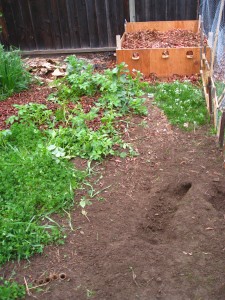 Once Upon a Lawn - This was all bermuda grass, at this time the bed had experienced the exuberance of our dog Sam. Amazing the damage such a small rascal can wreak
Now, a month into the new year things look very different compared to January ’08. The lawn has shrunk by 30%, there is now a fenced garden patch with several green manure cover crops growing happily, garlics and onions are knifing up at various places in the yard, and wildflower seedlings are poking their heads out of the soil.
My career focus has shifted as well. I am convinced that our world is in for some drastic shifts and changes within the next decade; the possibilities range from moderate global disruptions to outright collapse of many centralized/globalized infrastructures, severe hardship, and widespread disorder. I am convinced that food production lies at the center of it, so my energies are starting to focus in that direction. I am volunteering at Full Circle Farm and am a farming intern with Veggielution (a fledgling urban farming project). I would love to put my SJSU Computer Science studies to work in some dedicated way, but I am still trying to figure out where that fits in the whole equation. Which is all to say that 2009 is shaping up to be full of surprises.
Accomplishments and good experiences:
A flourishing, sheet mulched, hugelkultur bed
Tomatoes, Basils and Zucchini’s (oh my!)
Smaller lawn, bigger garden
A multi-functional raspberry/strawberry bed (eagerly awaiting February shipment)
Let Nature do the talkin’
TONs of reading (the book list is quite long thanks to Emily’s library sleuthing)
Water Wizard’s (greywater and water harvesting) workshop with Art Ludwig, Brock Dolman and the folks from the Regenerative Design Institute
Bioneers Conference (wow!) Highlights: Paul Stamets, Seed Exchange, Alexandra Cousteau, Ray Anderson, Janine Benyus and so many others
Failures and frustrations:
Almost anything I tried to do with bamboo (dog fence, path liner, trellis) failed miserably
Repeated invasions of our two rascal dogs and subsequent unsuccessful attempts at keeping them out of the garden they love and eagerly destroy with hearty romps and digging
Unhappy native plants (as I type the wildflower seedlings are probably being devoured – sigh)
Stupid carrots (I think I planted them at a bad time and too deeply)
Leggy seedlings in general (I need a cold frame or tiny greenhouse)
Haphazard design and layout (not always the best idea to “design as you go”)
Compost that refuses to heat up (I think I need a bigger pile and more green material)
What happened to the tarragon?!
One year has passed since I started seriously researching and growing my garden. I’m a renter so even though my landlord has been generous, there are limits to what I can do. These limits are good though, because they focus and refine the gazillions of possible arrangements down to what works within the the 500 square feet of garden space and the border along the ‘lawn’ in our backyard. Obviously this is the one of the core elements of wise design, making the most of what we have available to us within a given space. So for me, the big question is what does ‘making the most’ of my garden mean, and how do I do it? The answer to that question is what I will be pursuing probably for the rest of my life and is the primary purpose of this blog as I journal my thoughts, dreams, successes and failures in pursuit of abundant, creative and meaningful ways to grow food for myself and those around me.
Behind every garden are motivations and principles that bring it to life. For someone happening to glance through our gate, my garden would simply appear to be a source of food and beauty (well… calling my garden beautiful at this point would be a serious stretch but it’ll get there). The vegetables, fruits and wildflowers do provide these things, but while they are sprouting out of the physical soil of my yard they are rooted in my head. The garden would not be what it is (in all it’s tangled glory) were it not for a series of revelations that occurred over the last couple of years. I had an “aha!” moment when I read Gaia’s Garden , which introduced me to some permaculture philosophies and design concepts. From that point, my world exploded. Suddenly the garden became a partial, yet integral, answer to many of the other issues that have been weighing on me for a long time. The garden held ways to address global warming, peak oil, environmental destruction, pollution, sustainability, the list goes on….but on top of it all, the garden can provide food that TASTES GOOD and DOESN’T POISON YOU. And on top of THAT, growing food can also be beautiful, which appeases the artist in me who abhors the inefficient, rigid rows and completely banal look of the standard vegetable garden.
Now, if I sound a little sketchy when talking about poisonous food…sadly the reality is very disturbing. For example, recently two independent studies have shown that mercury may be frequently present in high fructose corn syrup (HFCS) . One of the studies showed that as late as August 2008, mercury is present in up to a third of popular brand name food products. Mercury is considered to be toxic at very small quantities, and our children are some of the highest consumers of products containing HFCS, so these reports are simply staggering. From the information I have been processing lately it is becoming clear to me that it is just the tip of an iceberg of toxicity, waste and greed that are at the core of the industrial US food system. I am fairly certain that in thirty or forty years we are going to look back in absolute horror at how we produced our food over the last few decades.
I could go on for quite some time on the ton of reasons behind my garden, but the bottom line is: my garden is a small but important way to carve out a better future for my wife and myself. My dream is to connect my garden with others within my community to start creating an urban network of food and habitat and start growing our way towards a healthier, more beautiful world.
|
|